
The same home, built differently: why high-performance housing is a fiscal responsibility
What lifecycle costing reveals about building standards and affordability
By: Lorrie Rand
When we talk about housing affordability, the conversation usually starts with what it costs to build. But for the people who actually live in these homes, that's only half the picture.
The more important question is: what does it cost to live there?
This is becoming more urgent. Governments across Canada are committing billions to new housing, and the decisions made now will shape the operating costs of thousands of homes for decades.
Recent announcements include approximately 600 new military housing units in Nova Scotia, with projects planned in Halifax and Greenwood. Programs like Build Canada Homes are supporting large-scale housing delivery across the country, too.
These are significant investments. They deserve to be made well.
The gap between "energy efficient" and actually efficient
Federal announcements describe the new military housing as "modern and energy efficient." Programs like Build Canada Homes use similar language and do encourage higher levels of performance, but "energy efficient" isn't a defined standard. Without firm, required targets, actual outcomes vary widely depending on how homes are designed and built.
In practice, that range is substantial.
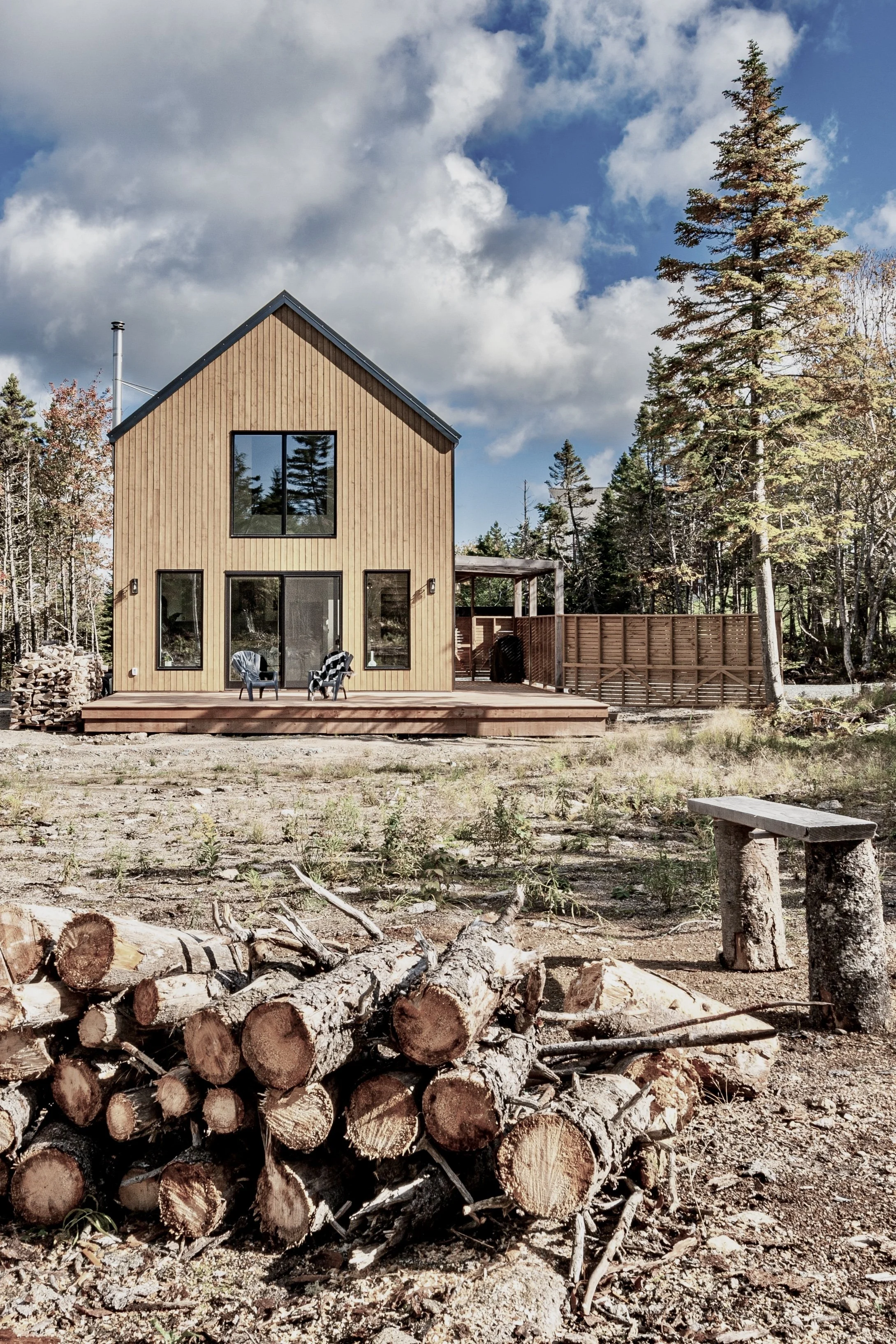
To illustrate this, we dusted off the design for the Sambro Creek house a modest three-bedroom, 1,200 sq. ft., all-electric home in Nova Scotia modeled using the Passive House Planning Package (PHPP.)
The results:
· Built to Tier 2 (Nova Scotia's current code baseline): ~27,000 kWh/year, roughly $2,600 in annual energy costs
· Built to Tier 5 / Passive House-aligned: ~9,465 kWh/year, roughly $800 in annual energy costs
That's a 65% reduction in energy use and $1,800 saved every year. Same home. Same lot. A different standard. Using Nova Scotia's current electricity emissions factor, the higher-performance home also reduces emissions by approximately 8.8 tonnes CO₂e per year.
Small decisions. Long consequences.
Homes built today will operate for 50 years or more.
$1,800 per year sounds modest. But multiply it across a program and a lifetime, and it becomes something else entirely.
For 600 homes in Nova Scotia alone:
· $1.08 million per year in avoided electricity costs
· $32.4 million over 30 years, in today’s dollars, before accounting for future electricity price increases.
· ~160,000 tonnes CO₂e avoided over 30 years
Every one of these outcomes hinges on a single decision made at the outset: how well the homes are designed and built.
What does building better actually cost?
This is where assumptions tend to get in the way.
High-performance homes are widely assumed to be significantly more expensive to build. Based on our experience, and recent costing work by Hanscomb for Habit Studio projects in Nova Scotia and New Brunswick, the incremental cost for high-performance multi-unit residential is currently in the range of 3–3.5%.
When performance is integrated early in the design process, that number is often even lower. The key is sequencing: performance requirements have to be set before design decisions are locked in, not added as an afterthought.
A question of fiscal responsibility
From a public policy perspective, the question is simple.
Should public investment prioritize the lowest upfront cost, or the lowest total cost over time?
Federal housing programs are about to deploy significant capital. If that investment doesn't include clear performance requirements, we risk building homes that are cheaper to construct and more expensive to live in. For decades.
That has real consequences: for household affordability, for energy system demand, and for the future retrofit costs required to bring homes in line with net-zero targets.
A practical path forward
There are two straightforward ways to align housing investment with long-term affordability.
Set performance conditions on publicly funded housing. Require new homes to meet high-performance or net-zero-ready standards. The targets already exist. They just need to be applied consistently.
Use lifecycle cost accounting. Evaluate projects on total cost over time, not construction cost alone. This is standard practice in other areas of public infrastructure. It should be standard here.
Neither of these is a new idea. Neither is consistently applied.
High-performance housing is often framed as a climate solution. It is.
But it's also something simpler: a way to build homes that cost less to live in.
The question isn't whether we can afford to build this way. It's whether we can afford not to.